
Chapter No. 10 · The Memoir · 9 min
Marriage 1: Nuclear Family, “How to Be a Teenage Wife”, Donald Trump, One Million Dollars
Recipe included.
I’ve been replaying those seven years with Wulf, especially the good parts. Even the tough bits look oddly cute at a distance.
When I first told friends and family, I climbed on my high horse: “I’m marrying an older man. He’s got his ducks in a row. You think my life is spiraling? Watch.” Teenage me even googled “How to be a Wife” and asked my grandmother (who survived the world’s Most Toxic Relationship, separated by a world war, until my No-Good Cheating Grandfather Finally Dropped Dead) what to do. I was building the “Nuclear Family” out of my AP U.S. History textbook. And considering she imagined I was off to Hollywood with Osama bin Laden, maybe it was predetermined to be nuclear; sans family.
(For the record: I’m fine with a partner who can lead, but leadership needs humility, emotional and physical safety, financial steadiness, and devotion to growth. And I should challenge him—and be challenged back. Unfortunately, at the time my only “manual” was grandma.)
Practical me surfaced one night over cocktails: “What’s our plan? A budget?” Wulf grinned: “Budget? Plan? We live like everyone else. And we drink like fish.”
Oh reader, this was foreshadowing in neon.

Our stay with his brother was brief. My gut twitched early, and I didn’t yet know how to hear it. I lived in my head.
Here’s the line that found me:
“Unexpressed emotions will never die. They are buried alive and will come forth later in uglier ways.”—Sigmund Freud
Grizzly and the rest of Wulf’s family slipped into Farsi even when we were speaking English. Wulf tried to loop me in, but the message was clear: you are not one of us. At night I would google Farsi phrases to fit in. Truthfully, I swallowed the shame and contorted—my long-term survival strategy, now under renovation. Most of the time, I was just hanging out with his baby niece, Nana, who loved me. I remember playing with her beautiful hair and spending time with her, locked in a room while the adults discussed adult things. I wanted to join, badly—but I didn’t have a seat at the table.
Our first big fight grew from that dynamic and my rising anxiety. Survival mode spiked. I missed my old Saturn and Homeboi—the version of me who was goofy and unguarded. In that house I felt watched, hushed, alone. No Homeboi, no scumbag high school friends, no music, no grandmother. No pets, no job, no classmates. I was isolated and looked to Wulf to fix it. Nightmares multiplied. He told his family I had social anxiety. Like many immigrant parents, they didn’t quite understand. The shame spiral tightened. I kept looking in the mirror, saying, “Get it together.”
One night he took us to a hotel to get away from it all. I broke down emotionally and told him everything. He said that if it came down to it—standing up for me or aligning with his family—he would reluctantly choose his family, set me up with an apartment and a care package, and send me off. Brutal clarity. If I’d been sovereign then, I would have taken that exit. I wasn’t.
Elder Autistic Suki’s Brief Public Service Announcement to Coming-of-Age Girlypops!
Reader, especially if you’re a young woman: think hard about your future. Your life, femininity, essence, and dreams are precious. I kept trading myself for harmony and calling it love. Rethink that trade.
If you grew up in chaos, you probably learned survival over intimacy. Brené Brown would call it armor. Mine looked like competence and charm—excellent at work, brutal on a nervous system that wants safety. Your body isn’t “woo”; interoception is data. When your chest tightens before family dinners, that’s your autonomic nervous system (hi, Stephen Porges) asking for safety. Real partnership is two adults turning toward each other (Gottman), not an adult and a committee. Different isn’t disloyal; it’s differentiation (David Schnarch): staying connected without shrinking yourself. Attachment styles aren’t aesthetics; if you feel like a beggar at the door of love, that pattern needs therapy, not a playlist. Healthy couples repair early and often; if every rupture becomes a trial, you’re tending a bonfire, not building a bowl. Shame will keep hiring your partners until you fire it. Once you start healing, it’s less theatrical than you fear and more practical than you think.
If you want to chat, and you feel alone, I’m here.
I never doubted Wulf loved me. He just didn’t love me enough to face his shame, loosen the family tether, and build something new with me. That, to me, is partnership. He split the difference: keep the family close, keep me too. But the crack had already formed. I buried it and stayed for years. The fracture widened without tools. In survival mode, I convinced myself I needed Wulf like air. I didn’t trust that an apartment and some cash could carry me onto my own path, the way Homeboi said it would, in Marriage 1 Bonus Chapter: Wulf Still Has My Respect, Homeboi, Self-Love and Tomorrow We Honor Our Good Times.
We didn’t know it yet. We chose denial, avoidance, and a little chaos.
And yes, the chaos was fun.
A monthly stipend appeared like magic and we lived like fools. Wulf introduced me to the finer things. I grew up where Michael Kors counted as “designer.” He upgraded my taxonomy: Cartier vs. Chanel, YSL vs. Gucci, and the poetry of watch movements. Most of my nicest pieces are stamped from that era. Well, what’s remaining, anyway.
Wulf was loving a wild spirit. I didn’t worship objects. He once gifted me Gucci’s entire bamboo collection, along with Roberto Coin earrings for all 10 ear piercings I have (I still do not wear earrings) I wore it to Venice Beach, downed a bottle of Maker’s Mark with Homeboi, and lost half of it to the Pacific.
Wulf’s face cycled from tan to emergency-red. This became a pattern.
“I’m sorry,” I said. “The water was so nice.”
“It’s fine, little one,” he sighed. His patience—accepting what he couldn’t change, like my feral wonder—kept us together far longer than probability suggested.
We ate at the best places. At home he DJ’d obscure histories, art, and music. I lay there watching cigarette smoke in spirals and tried to absorb a world I hadn’t been allowed to notice while surviving. I had little travel, limited media; my life was mostly interior.
A typical night indoors:
“…and that’s why Japanese denim is the best. Same principle as the way the Germans perfected—” He’s on the couch, smoking. I’m starfished on the floor. I pull at his pant-leg. He looks down, completely unfazed that I’m on the floor.
“Wulf, you ever want to run barefoot across grass at night?”
“What?”
“Let’s go. Right now.”
That was the world I brought him: imagination and child-like spontaneity. We painted together, splattering white clothes he somehow pulled off. Wulf consistently got stopped in the street for his style, and to model. We photographed each other. With what felt like an unlimited budget, all I wanted were toys: comics (I’ve always been a Spider-Man girl), video games, LEGO. Things I wanted but couldn’t afford growing up. He hadn’t touched that part of himself either; both of us, immigrant kids who grew up too fast.
He couldn’t cook. To this day he seems powered by chips, bacon, and breakfast burritos. I cooked at home, and I can still hear him calling his mother to announce it was better than any restaurant. That’s when I realized I love cooking: the alchemy of making someone I love that happy. He did show me one childhood favorite (Chef Suki Time!):
Baby Wulf’s Persian(ish) Hot Dogs with Peppers & Onions
My weeknight sosis bandari shortcut—fast, cheap, wildly cozy. Slightly upgraded since our era.
Ingredients (serves 3–4)
1 pack hot dogs, thinly sliced on the bias
1 small yellow onion, thinly sliced
2 green bell peppers, thinly sliced
2 tbsp tomato paste
2–3 tbsp neutral oil
½ tsp turmeric (optional but very Persian)
½ tsp paprika (smoked or sweet)
Pinch cayenne or red pepper flakes (I’ve used gochugaru before)
½ tsp sugar
Salt and black pepper
2–3 tbsp water
Squeeze of lemon or 1 tsp vinegar
Method
Heat a wide skillet over medium-high. Add oil and onions; cook 3–4 minutes until glossy. Add peppers; sauté 4–5 minutes until softened. Push to the sides; sear hot dogs 2–3 minutes. Clear a spot; fry tomato paste with a touch of oil 60–90 seconds until brick-red and fragrant. Season with turmeric, paprika, cayenne, sugar, salt, and pepper. Splash in water to glaze. Simmer 1–2 minutes until saucy. Finish with lemon or vinegar.
Serve like Wulf likes, over steamed white rice (rinse until the water runs clear), or pile into toasted buns or lavash with pickles. Bonus: parsley, jalapeños, sumac, or a dollop of yogurt. As for me? I like having it as a side dish—Korean friends have approved!

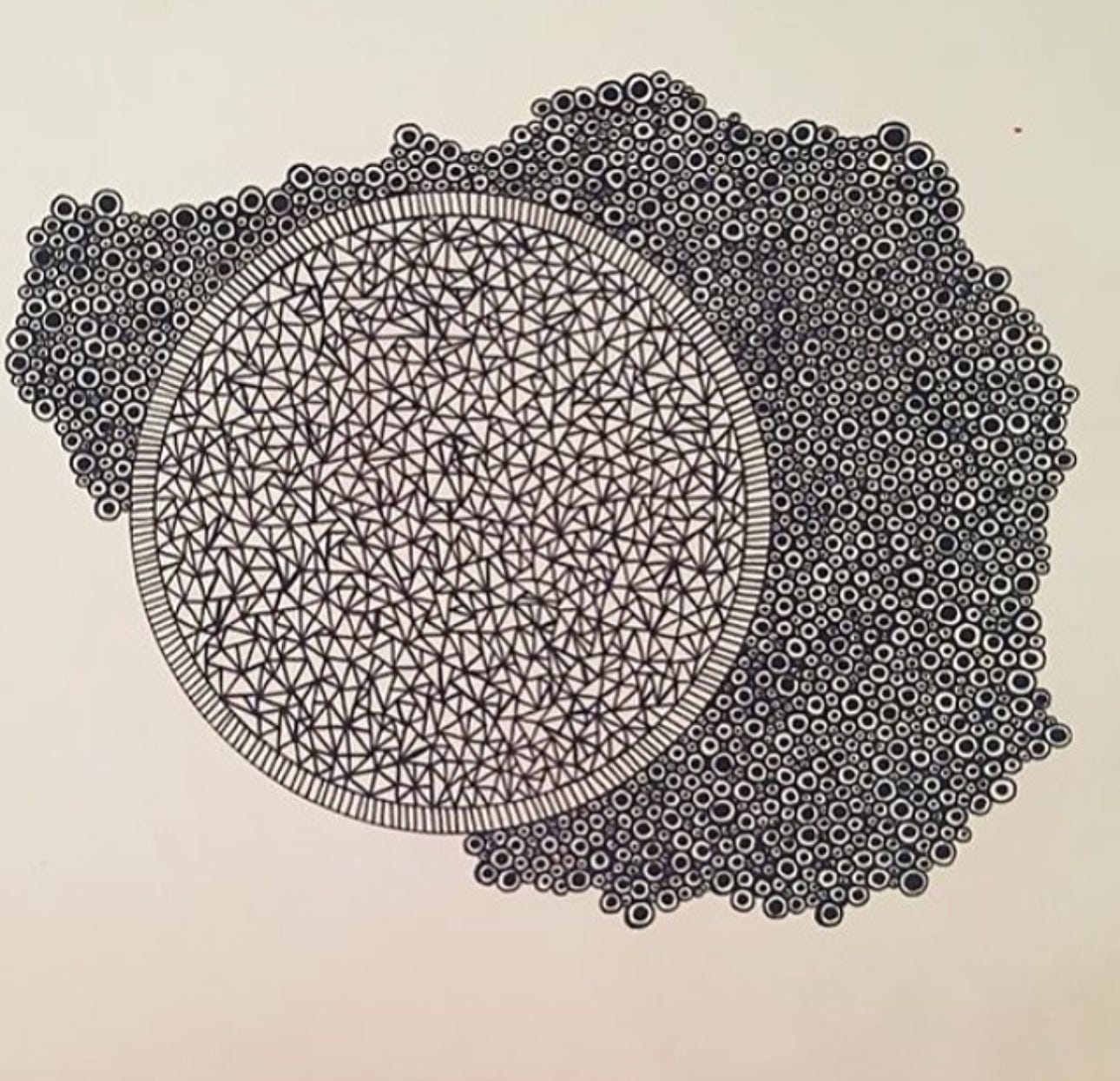
Another bond that kept Wulf and I together: Wulf believed in my art; so much more than I did. He sent me to art school. The problem was the ecosystem. It fed the work and starved the person. Like many tortured artists, I made pieces I still love while quietly dying. I needed reprieve.
Life got real, pretty quick: money issues, health scares, family deaths. We stayed when most couples would have tapped out. Fun, love, and respect carried us past logic. But so did my self-abandonment—shrinking while a fire in my chest whispered, You’re meant for more. I tried to talk Wulf toward that fire; he wanted family and was fine with how things were. Maybe contentment is wisdom; maybe it’s a lid. The fire kept growing. Over time, my heat annoyed him.
Age-gap relationships are lovely until the accelerant of one person’s becoming singes the other’s equilibrium.
Then politics raised the stakes. Trump blazing onto the scene; Iran–U.S. tensions worsened. Our dependence on Wulf’s family hummed with new anxiety. One evening he got off a long call with his father and said quietly:
“My parents are concerned. They’re coming to give us the last bit of money we’ll get for a while, maybe ever.”
“How much? What do we do?”
“A final million to split among us. I think we should buy a house and settle down.”
And that, dear reader, is where the next fault line opens.
The Memoir
The memoir is being written now.
Subscribe and chapters reach you as they’re drafted, long before the book is bound.